Good letter writing etiquette is what separates a note that reads as thoughtful and professional from one that quietly undermines you. The rules aren't complicated, but they matter — a misjudged greeting or a sloppy sign-off can distract from an otherwise strong message. Whether you're writing to a colleague, a client, a friend, or a potential employer, here are the dos and don'ts that keep your correspondence polished.
Match the greeting to the reader. Use "Dear Mr. Clarke," or "Dear Ms. Rivera," for formal letters (in the US, a colon after the name is common in business writing). When you don't know the name, "Dear Sir or Madam," works in the UK and "To Whom It May Concern," in the US. For friends, a simple "Dear Sarah," or "Hi Tom," is fine.
Say what you mean in plain words, and stay polite even when the subject is difficult — a complaint or a refusal lands better when the tone stays respectful. Avoid jargon, sarcasm, and anything that reads as passive-aggressive.
A formal letter should include the date, the recipient's details, a proper greeting, well-spaced paragraphs, and a matching sign-off. One-inch margins and a readable font keep it looking professional. For a full walkthrough of the layout, see our guide on how to write a letter.
Typos and grammar slips chip away at your credibility. Read the letter twice — once for sense, once purely for errors — and, for anything important, ask someone else to look it over.
In formal correspondence, add your contact details so the recipient can respond easily. Close with a polite line thanking them for their time.
Slang, abbreviations, and emojis have no place in professional correspondence. Save the relaxed tone for personal letters and keep formal writing measured and respectful.
The closing should mirror your greeting. In the UK, use "Yours sincerely," when you opened with the recipient's name and "Yours faithfully," when you didn't. In the US, "Sincerely," or "Best regards," cover most situations. Mixing these up is a classic etiquette slip.
A hurried letter reads as careless. Take a moment to consider the reader's perspective and the purpose of your message. If it's a sensitive matter, drafting it and returning later almost always improves the result.
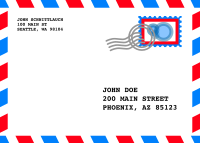
Etiquette doesn't stop at the last line. Address the envelope clearly, include a return address, and choose the right postage. For letters that carry weight — a cancellation, a formal complaint — many people opt for a tracked service such as Certified Mail (USPS) or Signed For / Recorded delivery (Royal Mail) so there's a record of sending and receipt.
Use "Dear Sir or Madam," in the UK or "To Whom It May Concern," in the US. If you can find the recipient's name with a quick check, though, a named greeting is always warmer and more effective.
Not at all. Handwriting adds intimacy for close relationships, but a cleanly typed and printed letter is perfectly polite — and often preferable for formal or professional correspondence where legibility matters.
Match the sign-off to your greeting. UK: "Yours sincerely," (name known) or "Yours faithfully," (name unknown). US: "Sincerely," or "Best regards." Leave space for your signature and print your name below.
Many of the same principles carry over — a proper greeting, a clear structure, a courteous tone, and a fitting sign-off — but email is generally a touch less formal. A physical letter still holds the higher standard.
Etiquette isn't about stiffness; it's about respect for the reader. Get the greeting, tone, formatting, and sign-off right, and your message comes through clearly and professionally. With the Letter app you can format and print a polished letter from your phone or computer, so the presentation matches the care you put into the words. If your next letter is a work one, our guide to business letter etiquette digs deeper into professional conventions.
This article was created with the help of artificial intelligence.