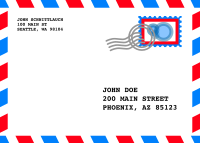
The standard business letter format is built from seven parts, and once you know them the whole thing becomes a template you can reuse forever. Whether you're writing to a client, a supplier, or a public office, following the accepted structure signals that you know what you're doing. This guide breaks the format down part by part, in the order they appear on the page, with a full block-style example at the end.
Start with your return address — or, if you have one, your company letterhead — followed by the date. In block style everything sits flush left. Write the date in full to avoid confusion between US and UK conventions: "14 March 2026" (UK) or "March 14, 2026" (US).
Below the date, add the recipient's details: their full name, their title, the company, and the postal address. Getting the title and spelling right matters more than people think — it's the first sign of care the reader sees.
Greet the recipient formally. "Dear Mr. Reed," or "Dear Ms. Rivera," is standard; US business writing often uses a colon ("Dear Ms. Rivera:") where UK writing uses a comma. When you have no name, "Dear Sir or Madam," (UK) or "To Whom It May Concern," (US) will do — though a named greeting is always stronger.
This is the substance. Keep it to two to four paragraphs, each covering a single point:
Stay formal and precise: no slang, and avoid contractions to keep the tone professional.
Sign off in a way that matches your salutation. UK: "Yours sincerely," (name known) or "Yours faithfully," (name unknown). US: "Sincerely," or "Best regards." Capitalize only the first word and follow it with a comma.
Leave three or four blank lines for a handwritten signature, then type your full name and job title beneath it. The signature is what turns a printed sheet into a formal, personal document.
If you've attached anything, note it below your name with "Enclosure" or "Enc." When the letter is going to someone other than the addressee too, add "cc:" and their name. These small conventions keep everything unambiguous.
12 Market Street Bristol, BS1 4RL
14 March 2026
Mr. Thomas Reed Operations Director Reed & Co. Ltd 8 Canal Road Manchester, M1 2WD
Dear Mr. Reed,
[Opening paragraph — purpose]
[Middle paragraph — detail]
[Closing paragraph — next step]
Yours sincerely,
Jane Doe Account Manager
Enc.
The heading (your address and the date), the inside address, the salutation, the body, the complimentary close, the signature, and any enclosures or extras. Together they make up the standard block-style format.
Block style is the most common business letter layout: every line is aligned to the left margin, paragraphs are single-spaced with a blank line between them, and there are no indents. It's clean, professional, and hard to get wrong.
Directly below your return address (or letterhead) and above the recipient's inside address. Write it out in full to avoid US/UK ambiguity.
Use a tool built for it. The Letter app applies a correct business-letter layout automatically, so the margins, spacing, and structure come out right whether you're on a Mac, iPhone, iPad, or Android device.
Master these seven parts once and every future business letter falls into place. For the writing process itself — what to actually say in each section — see our step-by-step guide on how to write a business letter, and to keep the tone professional throughout, read up on business letter etiquette.
This article was created with the help of artificial intelligence.