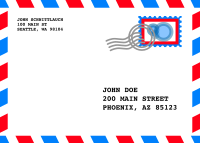
If you want to learn how to write a letter that actually lands, the good news is that the structure barely changes from one occasion to the next. Whether you're thanking a friend, catching up with family, or sending a formal note to a bank or landlord, the same building blocks apply: a heading, a greeting, a clear body, and a fitting sign-off. Get those right and everything in between falls into place. Here's a step-by-step guide you can follow every time you sit down to write.
Before you write a word, decide whether the letter is personal or formal, because that choice shapes everything else.
If you're printing on your own stationery, a single sheet of A4 (UK) or Letter-size paper (US) with one-inch margins keeps things clean and professional.
The greeting sets the tone in a single line.
Always follow a name you know with a comma; in US business letters a colon is common ("Dear Ms. Rivera:").
Don't bury the reason for writing. In the first paragraph, tell the reader why you're getting in touch: to thank them, to ask something, to update them, or to lodge a complaint. A reader who knows the point straight away stays with you to the end.
Keep each paragraph to one idea and move logically from one to the next. Concrete details do the heavy lifting: instead of "thanks for everything," write "thank you for driving two hours to help me move the sofa." For a formal letter, stay courteous and avoid slang and contractions. If you're not sure where the line sits, our guide to letter writing etiquette covers the dos and don'ts in detail.
Match your closing to your greeting and your relationship:
Leave space for a signature, then print your name beneath it.
Read the letter once for meaning and once purely for spelling, grammar, and punctuation. Reading it aloud catches clumsy sentences your eye glides over. If the letter matters, set it aside for an hour and return with fresh eyes. For a longer note that needs a personal touch, our tips on how to personalize a letter will help you make it feel like it could only have come from you.
Writing letters is where the Letter app comes in handy: you can compose, format, and print a clean letter from your iPhone, iPad, Mac, or Android device, so the layout looks right without any fuss.
Open with a greeting that fits the relationship: "Dear [Name]," for someone you know, "Dear Mr./Ms. [Surname]," for a formal contact, or "Dear Sir or Madam," when you don't have a name. Then state your reason for writing in the first line or two.
A personal letter is relaxed in tone and needs little more than a greeting and a friendly close. A formal letter follows a fixed layout — addresses, date, formal salutation, and a matching sign-off like "Yours sincerely" or "Sincerely."
Choose a sign-off that mirrors your opening. In the US, "Sincerely" or "Best regards" work for most formal letters; in the UK, use "Yours sincerely" when you named the recipient and "Yours faithfully" when you didn't. For personal letters, "With love" or "Warmly" suit the tone.
Long enough to make your point and no longer. Most personal letters run a page; formal letters are often shorter, ideally staying to a single side so the reader can take it in at a glance.
Writing a good letter isn't about fancy language — it's about a clear structure and a genuine message. Follow these steps, keep the reader in mind, and your next letter will read exactly the way you meant it.
This article was created with the help of artificial intelligence.